What happens when a woman struggles with menopause at work and nobody knows how to help?
Imagine a woman who has been with her company for 15+ years.
She knows her job inside out. She has led teams, delivered projects, and built a reputation as someone people can rely on.
But lately, she hasn't been sleeping well. She struggles to concentrate through long meetings. Some days, she feels exhausted before the workday has even begun.
She wonders if she's losing her edge. She hesitates to tell her manager what's happening because she's worried it might affect how she's perceived.
So she carries on, quietly.
Across the EU, around 85% of women experience at least one menopause symptom, and for an estimated 25–30%, symptoms are moderate to severe and can disrupt daily life and work. Yet Eurofound's 2024 European Working Conditions Survey found that only 15% of employees reported that their employer fully or partially accommodated disruptive menopause symptoms.
These findings come from different populations and shouldn't be treated as directly comparable. But they point to a shared challenge: women are navigating symptoms that can affect their working lives, while workplace support remains limited.
This is the reality for many women navigating perimenopause and menopause at work. And often, their colleagues and managers have no idea what they're going through.
At Miyara, we hear versions of these stories often. They make us think about an important question: Are workplaces doing enough to support women through this stage of life?
A new standard gives employers a place to start
On 7 September 2026, ISO published ISO 45010, an international standard providing guidance on menstruation and menopause in the workplace.
Why does this matter?
Because many organisations want to support women but aren't sure what that support should look like. Is an awareness session enough? Should there be a formal policy? What should managers know? What practical changes can make a difference?
ISO 45010 gives employers a shared reference point to start answering these questions.
It doesn't mean every company is now legally required to have a menopause policy. And it isn't a medical standard. Instead, it offers guidance on how workplaces can create more supportive environments for employees experiencing menstruation- and menopause-related health changes.
For HR leaders, this is an opportunity to move from good intentions to practical action.
Menopause support is about more than a policy
A policy is useful, but what happens when an employee actually needs support?
Can she speak to her manager without feeling embarrassed?
Does her manager understand that sleep disruption, fatigue, anxiety and brain fog can affect how she feels and functions at work?
Can she ask for a reasonable adjustment without having to disclose more personal information than she is comfortable sharing?
And does she feel that her experience will be taken seriously?
These everyday interactions can shape whether a woman feels supported or feels she has to manage everything alone.
The aim isn't to treat every woman going through menopause in the same way. Symptoms and experiences vary widely. It's to create a workplace where women can ask for support without fear of judgement.
What does ISO 45010 mean for your organisation?
The guidance encourages organisations to look at several areas:
Workplace culture: Can employees talk openly about menopause without stigma?
Policies and procedures: Do existing HR and occupational health policies address menopause-related needs?
Manager training: Do managers know how to respond with understanding and respect?
Workplace and work design: Could flexibility or practical adjustments make working days easier?
Privacy and disclosure: Can employees seek support while retaining control over what they share?
Evaluation: Is the support offered actually helping employees?
You don't need to overhaul everything overnight. A good starting point is to understand what your organisation already does well, where the gaps are and what employees say they need.
Where should HR leaders begin?
Start by asking your employees about their experiences. Review your current policies. Help managers understand menopause and how to have sensitive conversations. Explore practical adjustments that fit your workplace.
And remember: a policy sitting in a folder doesn't automatically create a supportive culture.
What matters is whether an employee feels able to ask for help when she needs it.
Supporting women through menopause isn't just about ticking a box. It's about helping experienced employees feel valued, understood and able to continue doing work they are good at.
How Miyara X Edge Compliance can help
We are excited to announce our partnership with Miyara Health, a women’s health startup working with organisations to turn menopause awareness into practical workplace support, training and employer benefits.
We at Edge bring the compliance expertise and AI assessment tools to support this valuable cause.
Together we help HR teams and team leaders make their workplace fit for women across life stages and make this visible through compliance to the new ISO 45010, international standard on occupational health and safety for managing menstruation and menopause in the workplace.
Our joint offering consists of:
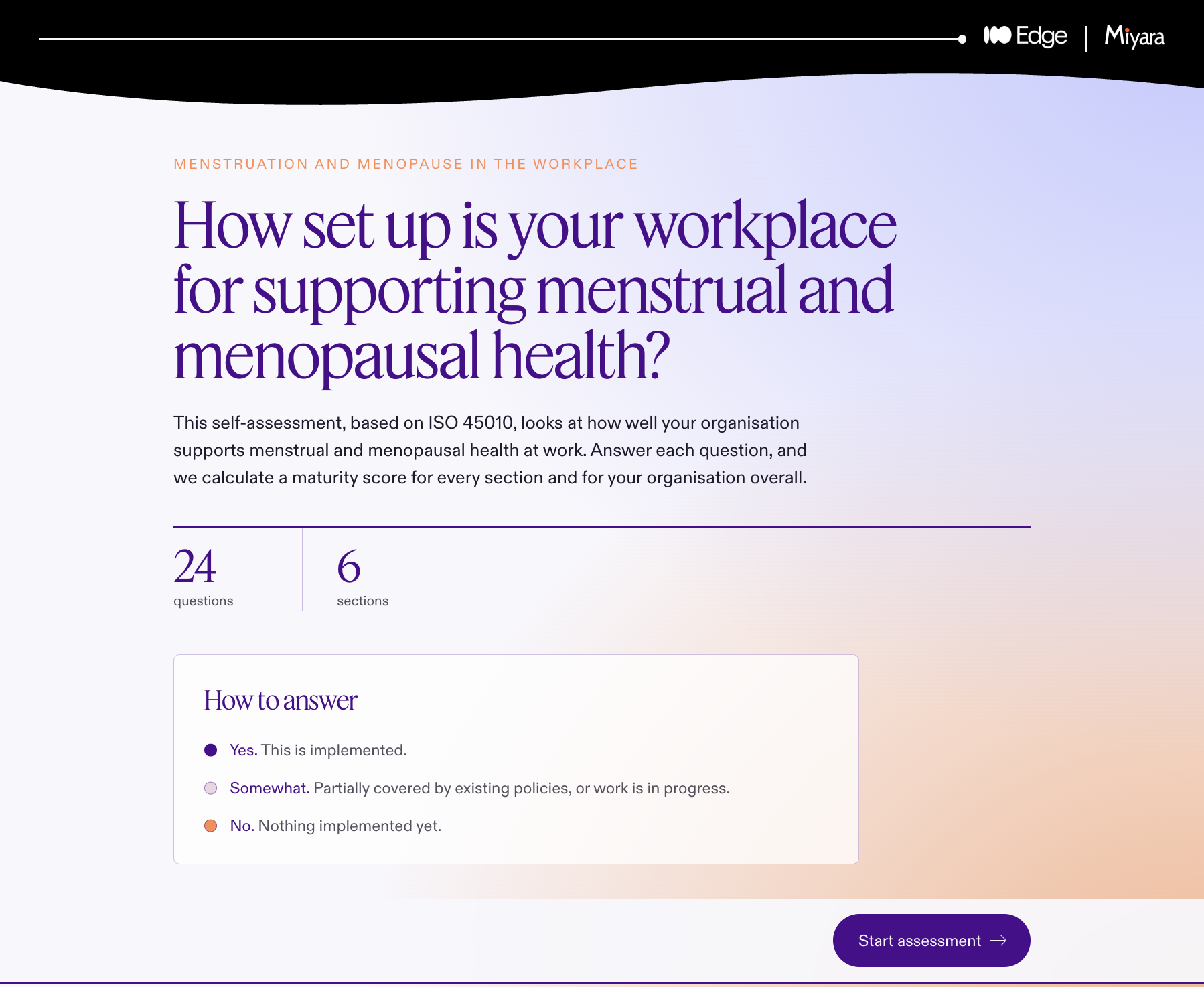
Self-assessment: 24 questions to see where you score against ISO 45010 (take it for free at: https://www.edgecompliance.co/portfolio/iso-45010)
Discovery call: a joint-session to understand your specific needs and goals
Gap analysis tool: red-lines your policies and gives you a bespoke action plan
Implementation support: we guide or complement your team’s efforts
Manager training: customised to your organisation and priorities
Conformity check: we audit and issue a report as proof of compliance
Complementary open office: advisory for managers and employees on request
The UK has made it mandatory for employers to make menopause adjustments. Globally, $150 billion are lost are year as an impact of women leaving the workforce during the menopause transition.
If you're an HR or People leader wondering where to begin, connect with us to receive our Menopause at Work Guide or discuss a webinar or workshop for your organisation.
Because a workplace that supports women through menopause is a workplace that takes their health, experience and contribution seriously.
Resources
Get in touch for a tailored quote at miyara@edgecompliance.co
Our service offering deck here
Try the online self-assessment to see how your company scores (no upload, no email)