

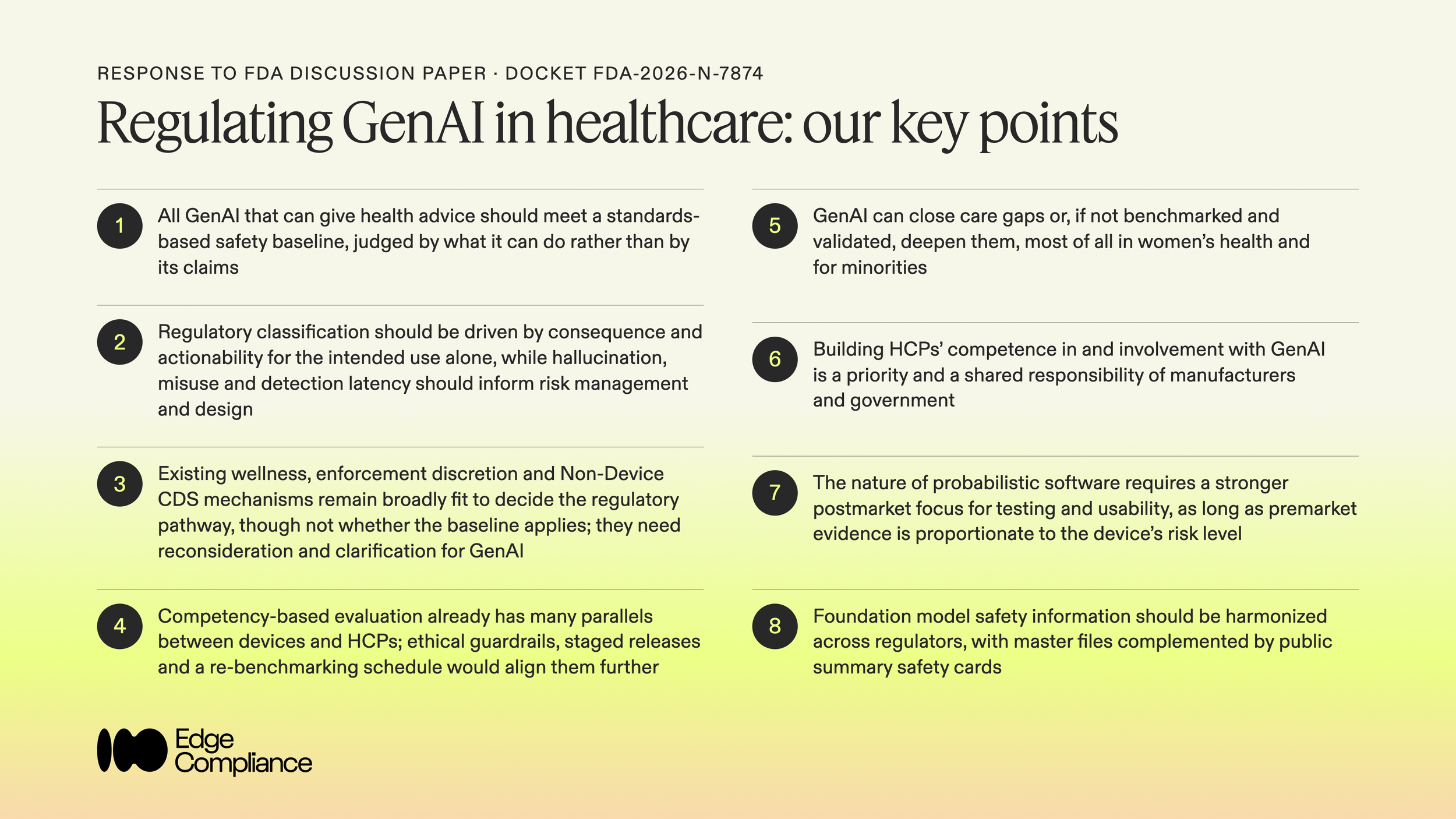
Edge Compliance has submitted a public response to the FDA on how we believe generative AI in healthcare should be regulated. The summary of our position is below, and we are happy to share the full annex with anyone who wants it.
What the FDA is asking
On 18 August 2026, the Digital Health Center of Excellence at FDA's CDRH released Considerations for the Regulation of Generative AI-Enabled Medical Devices, a discussion paper and request for feedback with 26 numbered questions and a comment deadline of 19 October 2026. It is not draft or final guidance and it does not propose policy changes, but it shows how the agency is thinking. Three ideas stand out.
The first is a two-axis risk framework. One axis scores how independently a GenAI function acts, from non-directive information to fully autonomous action. The other scores the consequence of relying on a wrong output. Evidence expectations follow the position on the grid, not the mere presence of an LLM.
The second is a competency-based approach to premarket evaluation, modelled on how clinicians are credentialed: standardised benchmarking of the deployed configuration, then clinical confirmation of increasing rigour, then ongoing assessment in use. The paper lists ten benchmarking elements, including safety-critical recognition and escalation, scope maintenance and boundary adherence, calibration and clinical deferral, robustness and reproducibility, and subgroup performance.
The third is a question about balance: whether FDA should accept more premarket uncertainty in exchange for stronger postmarket monitoring, such as periodic re-benchmarking, clinician review of real-world outputs and drift detection.
What we see on the ground
We support women's health startups working at the borderline between medtech and wellness, and more and more of them are now integrating generative AI through chatbot or MCP functions. Everyone seems to be working out GenAI safety alone, and everyone meets the same challenges: hallucination risk, scope creep, mis-escalation and accuracy.
Technical teams are also converging on the same answers: automated evaluation pipelines (evals), swappable architectures, lower-temperature and therefore more deterministic models, and local specialised models where possible, for better control of privacy and security. It is reassuring that these line up closely with the elements FDA now proposes to benchmark. Hallucination maps onto calibration and false confidence, scope creep onto boundary adherence, mis-escalation onto under- and over-escalation, and reproducibility onto robustness testing. The paper also raises the question of foundation model changes initiated by the model developer rather than the device manufacturer, which is exactly why swappable architectures need evals running behind them.
Meanwhile, healthcare professionals urgently need training on how to use and contribute to GenAI products. My recent trip to China with FemTech Weekend and Zhu Yihan showed me what can be achieved when this is truly clinician-led. GenAI can close care gaps. If it is not benchmarked and validated, it can also deepen them, most of all in women's health and for minorities.
The gap: safety shouldn't depend on classification
Our key conclusion is that this should not concern only medical devices. FDA's own framing is that it regulates devices, not GenAI as such. That is legally coherent, but it leaves a very large population outside the picture. OpenAI's January 2026 report found that more than 5% of all ChatGPT messages are health-related, with roughly one in four regular users asking a health question every week and more than 40 million people doing so every day. Millions of people are using general-purpose LLMs for health advice, with no regulatory classification attached at all.
Our recommendation is that any GenAI used for health should be expected to meet basic safety benchmarks, irrespective of how the product is classified.
A simple example shows why. A GenAI tool that supports conception is low risk, while one that supports contraception is high risk; FDA's first clearance of a contraceptive app, Natural Cycles in 2018, came through the De Novo pathway as a Class II device. The classification, and the clinical and regulatory pathway that follows, differ greatly. Yet both tools can drift into diagnosing other conditions, giving emergency advice or advising pregnant women and other vulnerable users. The risk profile is different, but the safety baseline and the technical considerations for GenAI are the same.
Companies shouldn't have to figure this out alone
We are currently supporting three non-device, wellness products with exactly these considerations. They do not need to be regulated by FDA. But they need a standardised framework for what health GenAI safety should look like, even under the Wellness Policy, where FDA's January 2026 update treats labelling, user interface and functionality as part of intended use, so a disclaimer alone is unlikely to carry the weight. Founders with limited budgets and high stakes should not have to work this out on their own.
Acknowledgements
I am grateful to have contributed to this moment, truly at the edge of regulatory science. Heartfelt thanks to our fellow QARA and product experts Arturo Sánchez-López and Steph Rowan, to our tech advisors Matan Eylon and Aurelio Ogliari, and to the clients who gave us feedback. Onwards.
References
FDA CDRH, Considerations for the Regulation of Generative AI-Enabled Medical Devices: Discussion Paper and Request for Feedback, 18 August 2026
FemTech Weekend - Shanghai Summit
Methodology note: This article is based on my original LinkedIn post (link), reflecting Edge Compliance's public response to FDA's GenAI discussion paper and our experience supporting women's health startups at the medtech and wellness borderline. AI assisted in elaborating the topic into a broader article. All analysis and regulatory perspectives are our own, and all content has been reviewed for accuracy.
