
The price tag on being a woman
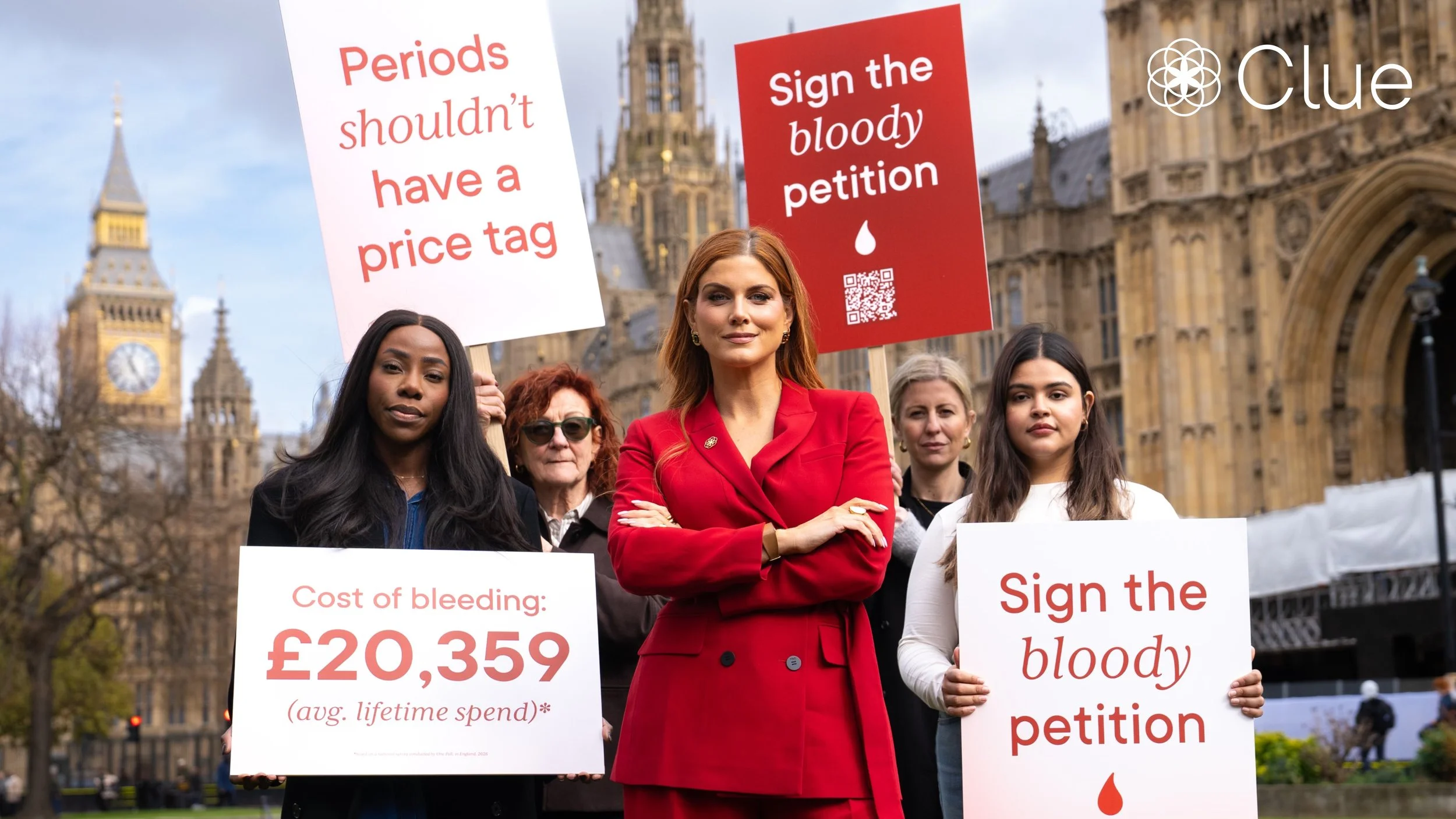
Clue’s cost of bleeding campaign (https://helloclue.com/landing/costofbleeding)
Women literally birth and raise society, but are left to care alone for the very physiology that allows them to do it. Having a period is not considered a "condition." Most menstrual dysfunctions still take a decade to diagnose. So the financial burden of managing basic reproductive biology lands, almost entirely, on the individual.
The cost
Clue put an actual figure on it: £20,359 over an average 38-year menstrual lifetime — roughly the price of a new car, spent quietly on period products, pain relief, replacement clothing, and private appointments, with no easy opt-out. The research behind it is solid: a 2,000-person UK consumer survey run by OnePoll, covering routine monthly costs (products, symptom relief, laundry) rather than one-off big-ticket items. Clue has partnered with broadcaster and women's health advocate Ashley James on the campaign, called Cost of Bleeding, which is petitioning for period products to be made free and widely available in England — Scotland and Northern Ireland already provide them.
And that number is the floor, not the ceiling. It's just the bleeding. It doesn't touch contraception, birth, missed income years, or menopause — hormone therapy, early retirement, the whole second half of the reproductive story. Add those in and the real lifetime figure is considerably higher.
Doing the math
Here's the thought experiment I keep coming back to. Suppose we fixed the gender pay gap tomorrow — full parity, done. Women would still be roughly £20,000 worse off than men over a lifetime, from birth, purely from the cost of a bodily function they didn't choose and can't opt out of.
Except we haven't fixed the pay gap. The EU's own 2023 figures put women's average hourly earnings 12% below men's, a gap that's barely moved over the past decade. UK data for 2025 puts it at a similar 12–13%. In the US, the gap is wider still — women earned roughly 19% less than men in 2024, according to labour research trackers, and the gap widened again rather than narrowed. So the £20,000 "bleeding tax" isn't landing on a level playing field. It's stacking on top of an already-unequal one.
I can't think of another health-related cost that a specific group carries so exclusively, for something so entirely outside their control, layered on top of an existing earnings disadvantage. That combination — a mandatory biological cost plus a lower baseline income to pay it from — is what makes this a structural issue, not an individual budgeting problem.
Why "not a condition" is doing a lot of work
This is where my own corner of the field connects directly. I've written before about the regulatory gap between period products and other everyday health products — tampons and pads are treated as consumer hygiene items, while a plaster covering a paper cut is regulated as a Class I medical device with defined safety and quality requirements. That asymmetry isn't an accident; it reflects the same underlying assumption Clue's campaign is pushing back on — that menstruation is a lifestyle inconvenience to be privately managed, not a physiological reality that warrants the same baseline protections and support as other health needs.
The cost data makes the same point from a different angle. Beyond the direct £20,359, separate NHS Confederation research estimates that women missing work due to painful periods, endometriosis, fibroids, and ovarian cysts costs the UK economy around £11 billion a year. That's not a personal finance problem either — it's the downstream cost of treating a whole category of physiology as outside the scope of "real" healthcare, right up until it shows up as lost productivity on a national balance sheet.
A societal issue, not a women's health issue
That reframe is the one I'd underline. "Women's health issue" implies a niche concern for a subset of the population to solve for itself. What Clue's data actually shows is a cost that's universal to roughly half the population, compounded by an income structure that makes it harder for that half to absorb it. That's a societal design flaw, and it should be treated — and funded — like one.
I signed the petition, and I'd encourage you to as well, even if you're not in the UK. Regulatory and policy precedent in one country has a way of travelling — Scotland and Northern Ireland's existing provision is proof that this is achievable, not aspirational.
References
Clue, Cost of Bleeding campaign and consumer research (OnePoll survey, n=2,000 UK adults who menstruate), 2026 — wf.helloclue.com/landing/costofbleeding
European Commission, The gender pay gap situation in the EU, 2023 data
Institute for Women's Policy Research / Economic Policy Institute, US gender wage gap analysis, 2024–2025 data
NHS Confederation, CREATE Health Foundation & London Economics, report on economic cost of women's health conditions in the UK
Giulia Paggiola, Plasters Vs Period Products, Edge Compliance blog — edgecompliance.co/blog/plasters-vs-period-products
Methodology note:This article is based on my original LinkedIn post (link), written in response to Clue's Cost of Bleeding campaign, reflecting my professional experience and personal perspectives on menstrual health equity and regulation. AI assisted in elaborating the topic into a broader article by integrating background research, fact-checking of the underlying statistics, and additional economic and regulatory context. All analysis and perspectives are my own, and all content has been reviewed by me for accuracy.
