
Translating your device into "regulatorese"
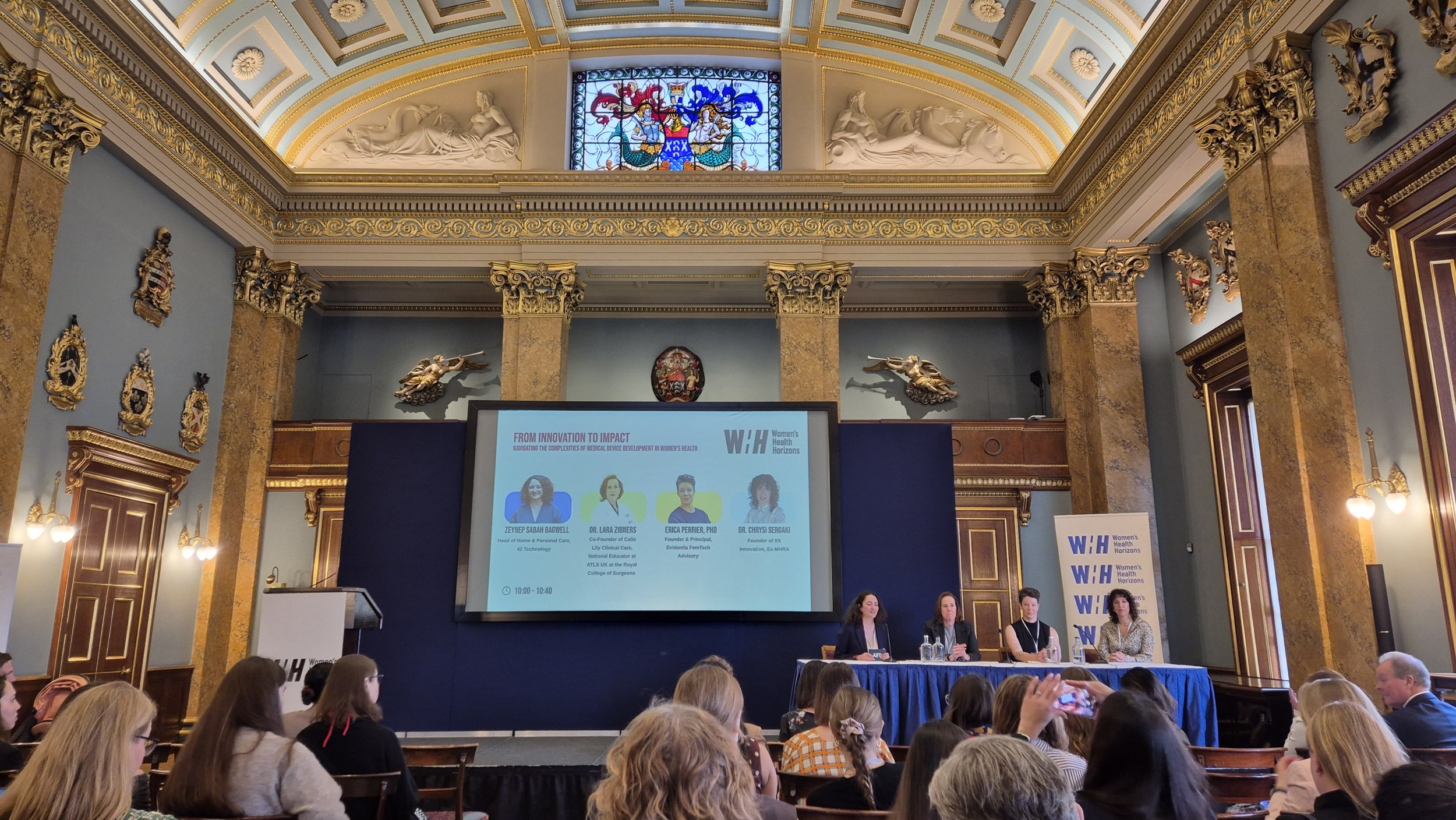
Erica Perrier speaking on the WHH panel: From Innovation to Impact
Struggling to translate your device characteristics into "regulatorese"? You're not alone, and it turns out the fix starts with three deceptively simple questions.
Where this started
Last week, my friend and close collaborator Erica Perrier, PhD, MS, CSCS was on stage at the Women's Health Horizons London summit talking about medical device innovation. She made a point that sounded almost too basic to matter — until the room's reaction told her otherwise. She asked builders to take a piece of paper and write down three things: what does your device do, who is it for, and how does it work. Simple questions, genuinely harder to answer precisely than most founders expect. And your answers to exactly those three questions are what determines your regulatory pathway.
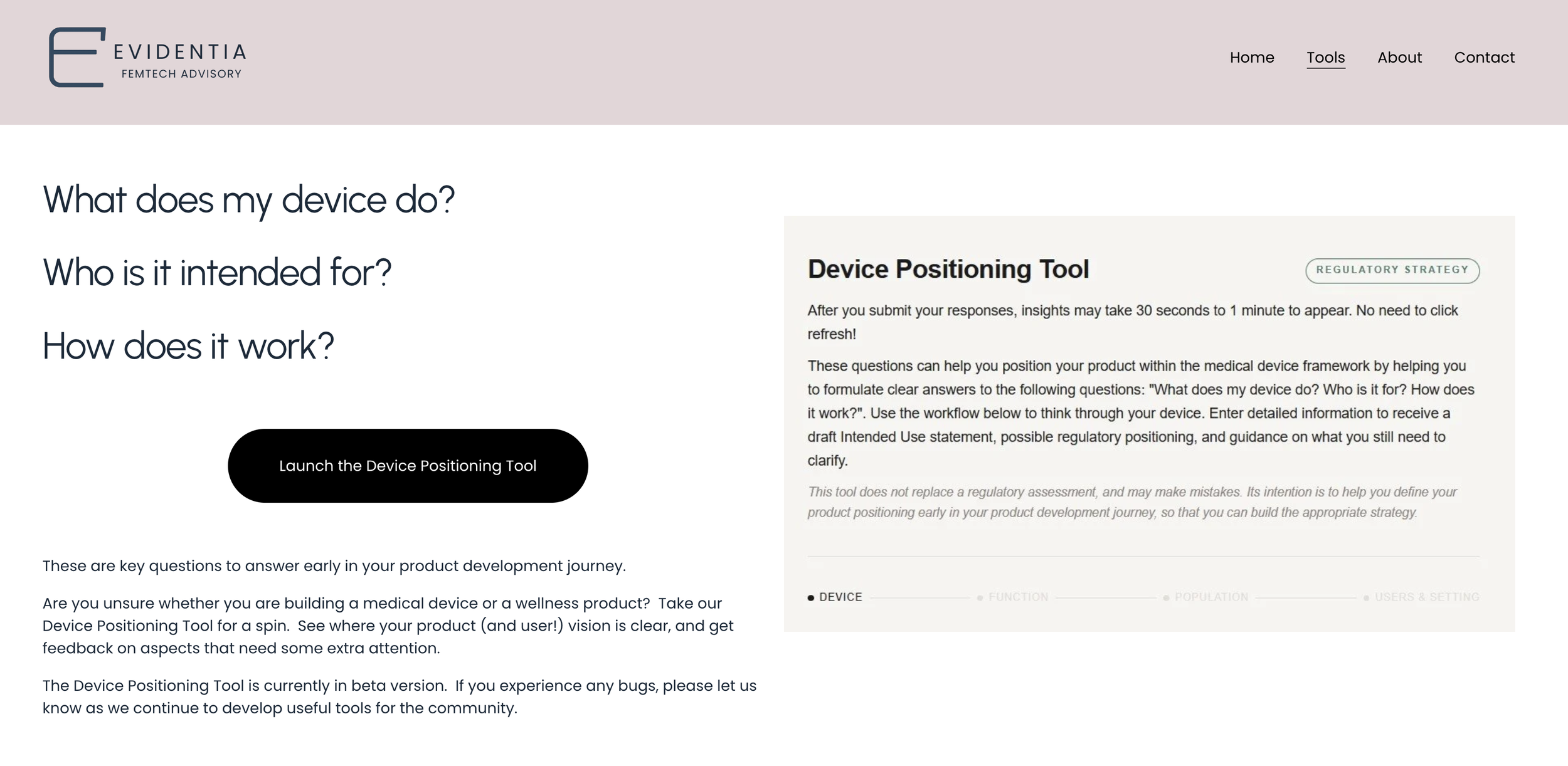
Erica didn't stop at the talk. She built a free AI-based tool that pushes founders to get specific on the same three axes — whether the device diagnoses, treats, or monitors; who exactly the target population is (down to condition and patient type); how it interacts with the body; and what outputs it produces. From there, it gives an early directional read on likely classification and flags what to keep in mind as you build.
What I found testing it
I ran it against a few fertility-device scenarios, my own corner of the field, and it held up well on the fundamentals. It correctly separated a wellness use case from a contraceptive one — a distinction that looks cosmetic from the outside but is regulatory night and day, since a contraceptive claim pulls a device straight into medical device territory regardless of how "wellness" the rest of the product feels. It also caught the difference between qualitative and quantitative output types, which matters more than most non-specialists assume: a device that gives a binary "fertile / not fertile" read is regulated very differently from one reporting an actual hormone concentration, because the latter carries a different evidentiary and validation burden.
Where it fell short was exactly where I'd expect an AI tool to fall short: the nuance of conception-only claims (as opposed to contraception or general cycle tracking), the IVD-type categorisation question, and a few other calls that, honestly, only come from doing this work for years. But even there, it pointed founders at the right questions to bring to an expert, and the intended use statement it drafted was better than most I see from teams who've been at this for months.
That's the right bar for a tool like this. It's not a replacement for a regulatory strategist — Erica is upfront about that — but as prep work for your first real conversation with one, it's genuinely useful, and free.
Why those three questions actually decide your pathway
It's worth spelling out why "what / who / how" isn't just a nice framing device — it's the literal decision tree regulators use.
Take fertility devices, since that's what I tested. The 2018 FDA clearance of Natural Cycles as the first app-based contraceptive is a clean case study: the same underlying signal — basal body temperature and cycle data — produces three entirely different regulatory products depending on the claim attached to it. Natural Cycles itself ships in three modes (contraception, conception, and pregnancy), each carrying its own intended use and its own evidence expectations, even though the input data barely changes.
The qualitative-versus-quantitative distinction Erica's tool caught is just as consequential. Published comparisons of quantitative versus qualitative hormone testing for personal fertility monitoring show these aren't interchangeable design choices — they carry different diagnostic performance profiles and, by extension, different validation requirements. A device that tells you "high" or "low" fertility is a different regulatory animal from one reporting an estradiol or LH value in defined units, even if the underlying sensor is similar.
This is precisely why "what does it do, who is it for, how does it work" has to be interrogated early and precisely, not as a marketing exercise but as a design constraint. Get vague on any one of the three, and you either under-claim (leaving value on the table) or over-claim (walking into a classification and evidence burden you didn't plan for).
A short checklist for your first regulatory conversation
If you're preparing to talk to a regulatory professional for the first time, bring answers to:
What does the device do — diagnose, treat, monitor, or something else — stated as precisely as possible?
Who is it for, down to the specific condition or population, not just a demographic?
How does it work — what's the mechanism of interaction with the body?
What does it output — a qualitative signal, a quantitative measurement, or a recommendation — and what happens downstream of that output?
Answer those with precision, and the first conversation with your regulatory consultant goes from "let's figure out what this even is" to "let's map the pathway." That's a genuinely different — and much cheaper — starting point.
On the tool itself
What struck me most wasn't just what the tool got right, but how quickly Erica went from a stage observation to a working, freely shared instrument for the community. That's not a small thing in a field where most people who build this kind of expertise keep it close.
References
Erica Perrier, PhD, MS, CSCS — LinkedIn / Evidentia Consulting & FemTech Advisory
U.S. FDA, De Novo Classification Request, Natural Cycles (DEN170052), 2018 — first FDA-cleared app-based contraceptive
Bouchard, T.P., Fehring, R.J., Mu, Q. (2021). Quantitative versus qualitative estrogen and luteinizing hormone testing for personal fertility monitoring. Expert Review of Molecular Diagnostics, 21(12), 1349–1360.
Methodology note:This article is based on my original LinkedIn post (link), reflecting my professional experience testing Erica Perrier's tool and my perspective on fertility device classification. AI assisted in elaborating the topic into a broader article by integrating background research, regulatory references, and additional context on fertility device classification precedent. All analysis and regulatory perspectives are my own, and all content has been reviewed by me for accuracy.
