
Top nominated!
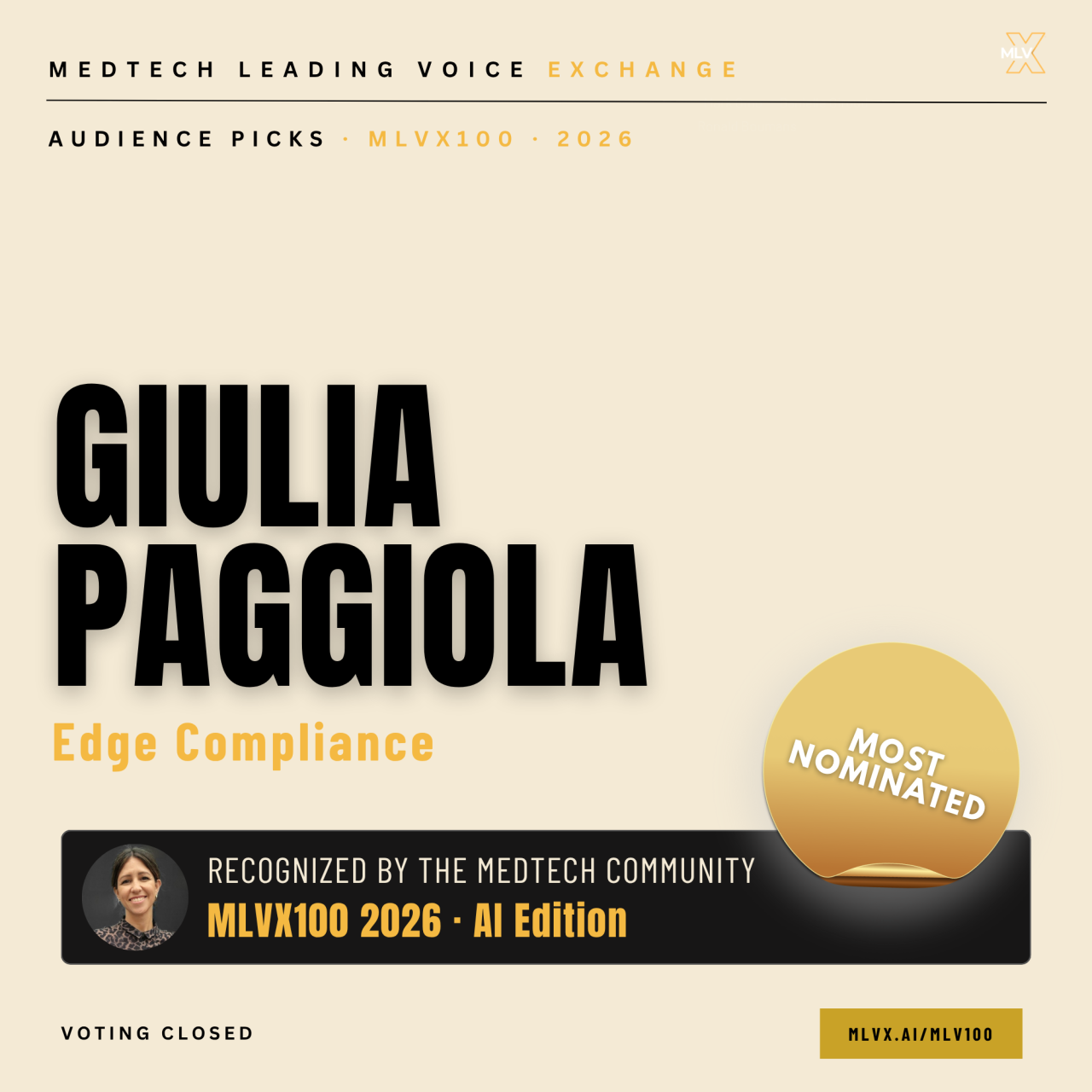
Results of MLVX nomination for Top Voices of Medtech: https://mlvx.ai/mlv100
I've just been featured among the top new voices in medtech, and I'm genuinely chuffed.
Why I write
I've been writing one LinkedIn post a week for almost a year now — regulatory news and analysis, quality tactics, and general reflections on the sector, femtech in particular. I never set out to be a content creator. The intention was always simpler: share my thinking on the frontier developments we observe and the general topics we're actually working on at Edge Compliance. I hope it sparks new reflections and ideas for the audience I write for — mostly healthtech founders, QARA professionals, and adjacent services, largely in women's health and digital health.
The 2.24 hours nobody asked for
My time-tracking tool tells me I spend an average of 2.24 hours per post. Some people tell me that's too much, that I should automate more of it. But the process is deliberately manual — AI supports the research, the critique, and the proofreading, but nothing more than that. I hope it shows.
It turns out that hope has some real backing behind it. LinkedIn launched a formal crackdown on generic AI-generated content in May 2026, and by July an independent analysis of 5,000 public LinkedIn posts found that over 81% read as likely AI-generated. LinkedIn has since rolled out a "seems like AI slop" reporting button, and separate research measuring the platform's most recognisable AI tell — the "it's not X, it's Y" contrast formula — found it now costs authors roughly 5% of their own baseline reach, an effect that wasn't even measurable before this year. We are all, apparently, sufficiently enraged by the same thing: I genuinely cannot read another "This is not X. This is Y." without pulling my hair out.
Does that mean genuinely human content drowns in the flood, or stands out against it? Given what the data above actually shows, I trust the latter — and I'd rather bet my weekly 2.24 hours on that than on shortcuts that increasingly read, and perform, as exactly what they are.
Ten voices worth your feed
Here's my personal top-10 list of LinkedIn voices in medtech: genuinely human, honest, informative, curious, not know-it-all-sy. That's the register I try to write in myself, and the one I look for in others.
Acacia Parks, PhD, MBA, RAC — FDA regulatory
Yujan Shrestha, MD — FDA regulatory
Prof. Dr. Christian Johner — EU MDR & AI
Erik Vollebregt — legal/regulatory interface
Monir El Azzouzi — QARA podcast
Blythe Karow — US commercialisation & wearables
Louise Barrett — wearables & digital health
Eric Sugalski — strategy
Adam Isaacs Rae — quality/auditing best practices
Elena Kyria — recruitment trends
The comment that made it worth it
One of the people who voted for me described me as a "leading voice for borderline medtech wellness devices" very engaged with high-quality regulatory analysis on LinkedIn. That single line is well worth every one of my weekly one-to-three hours of slightly OCD editing.
Thanks to everyone who's voted so far, and to Sean Smith for the feature.
Methodology note: This article is based on my original LinkedIn post (link), reflecting my personal thoughts on being featured as a top new voice in medtech and my approach to writing weekly content. AI assisted in elaborating the topic into a broader article by adding background research on LinkedIn's 2026 AI-content crackdown and measured reach effects of common AI writing patterns. All personal reflections and opinions are my own, and all content has been reviewed by me for accuracy.
