
Inside SPRIND’s jury for Continuous Hormone Monitoring

The SPRIND jury for Continuous Hormone Monitoring
We're working hard to bring Continuous Hormone Monitoring to women's health as fast as we possibly can. That's the shared mission of the jury I'm proud to be part of for SPRIND — Bundesagentur für Sprunginnovationen's CHM Challenge, and the more time I spend in the room with this group, the more humbled I am by the range of expertise sitting around the table.
Biosensor R&D (CGM)
Dr. Michael Schoemaker brings deep CGM R&D experience from his work at PharmaSens, where he has been developing integrated insulin delivery and continuous glucose sensing systems — precisely the kind of hard-won, hands-on sensor engineering knowledge that matters when evaluating whether a hormone biosensor concept can actually survive contact with real bodies and real regulatory pathways.
OB-GYN clinical practice
Professor Eugene Oteng-Ntim brings over three decades of clinical OB-GYN practice as Head of Obstetrics at Guy's and St Thomas' and Professor of Obstetrics at King's College London — where he became the first Black professor of obstetrics in the university's history. His research spans sickle cell disease in pregnancy and maternal health outcomes, including leading the TAPS2 trial and contributing to the UPBEAT study on maternal obesity. When a Challenge use case touches early detection of preeclampsia or other pregnancy complications, his is exactly the clinical judgment you want at the table.
Metabolic health research
Professor Susanna Hofmann leads the "Women and Diabetes" research group at Helmholtz Zentrum München and holds a professorship in lipid metabolism and metabolic disease at LMU Munich. Her work focuses specifically on how metabolic processes and cardiovascular risk differ between men and women — a research focus that exists precisely because, as she's put it publicly, women's metabolism and immune systems don't simply scale down from male physiology, they work differently.
Bioelectronics tech
Professor Sheng Xu, recently named a 2026 Guggenheim Fellow and now at Stanford after a decade at UC San Diego, is one of the field's leading voices in bioelectronics — his lab has pioneered wearable ultrasound patches capable of continuous, non-invasive monitoring of deep tissue signals like blood pressure and cardiac activity. That's the exact category of engineering challenge — getting a sensor to measure something meaningful, continuously, without tethering the wearer to a lab — that sits at the heart of what this Challenge is asking teams to solve.
Lifescience entrepreneurship
Rowan Gardner brings over 30 years of experience applying computational methods to life science and patient data, as co-founder and Chief Business & Investment Officer of PrecisionLife, which uses AI to connect chronic disease patients with more effective treatments. She also sits on the board of Digital Health and Care Wales, overseeing digital governance and safety for NHS Wales — a perspective that keeps the jury honest about what it actually takes for a breakthrough sensor to become a deployable clinical tool.
Deep-tech investment
Dr. Saurabh Tak rounds out the panel with a deeptech investment lens, evaluating not just whether the underlying science is sound but whether a given team's technical approach has a credible path to becoming a fundable, scalable company.
Regulatory strategy - where Edge fits in
My own seat on this panel traces back to a fairly unusual combination of training, and of course to my close connection with Clue and Ida Tin, its founder.
I started in chemistry, with a PhD focused on enzyme catalysis and pharmaceutical synthesis. This turned out particularly helpful in order to understand hormone-protein interactions, biochemical electrodes and enzyme activation strategies presented by the candidates.
Having been part of Clue's FDA clearance as a digital contraceptive is the precedent that shows a femtech product can cross from consumer wellness into genuinely regulated, clinically trusted territory, and do it without losing the qualities that made it usable and beloved at scale in the first place.
Since then, my work through Edge Compliance has spanned a genuinely wide range of device types: digital health platforms, AI-enabled software, and invasive hardware sensors, sometimes for the same client at different stages of the same product's life.
That cross-disciplinary habit and eye for regulatory feasibility is what I bring to this jury.
Plus the team making it all run
None of this happens without the people designing and running the Challenge itself. Ida Tin, who founded Clue and coined the term "femtech," is directing the Challenge — bringing the perspective of someone who spent years trying to get institutional capital and attention pointed at women's health before the category had a name. Marcia Holst, Jano Costard (SPRIND's Head of Challenges), and Michael Lößl handle the guidance and organisation that turns a jury's judgment into an actual, well-run selection process — a genuinely underappreciated skill given how many moving parts a Challenge like this has.
Why this composition matters
Every person on this panel can independently interrogate a different failure point: Is the sensor physics sound? Would this actually work in a pregnant body, not just a lab model? Does the metabolic framing account for real sex-based physiological difference, or is it borrowing male-normed assumptions? Could this realistically become a company, not just a paper?
That's the level of scrutiny a field this early-stage and this underfunded actually needs — and it's a genuine privilege to be doing this work alongside people this good at it.
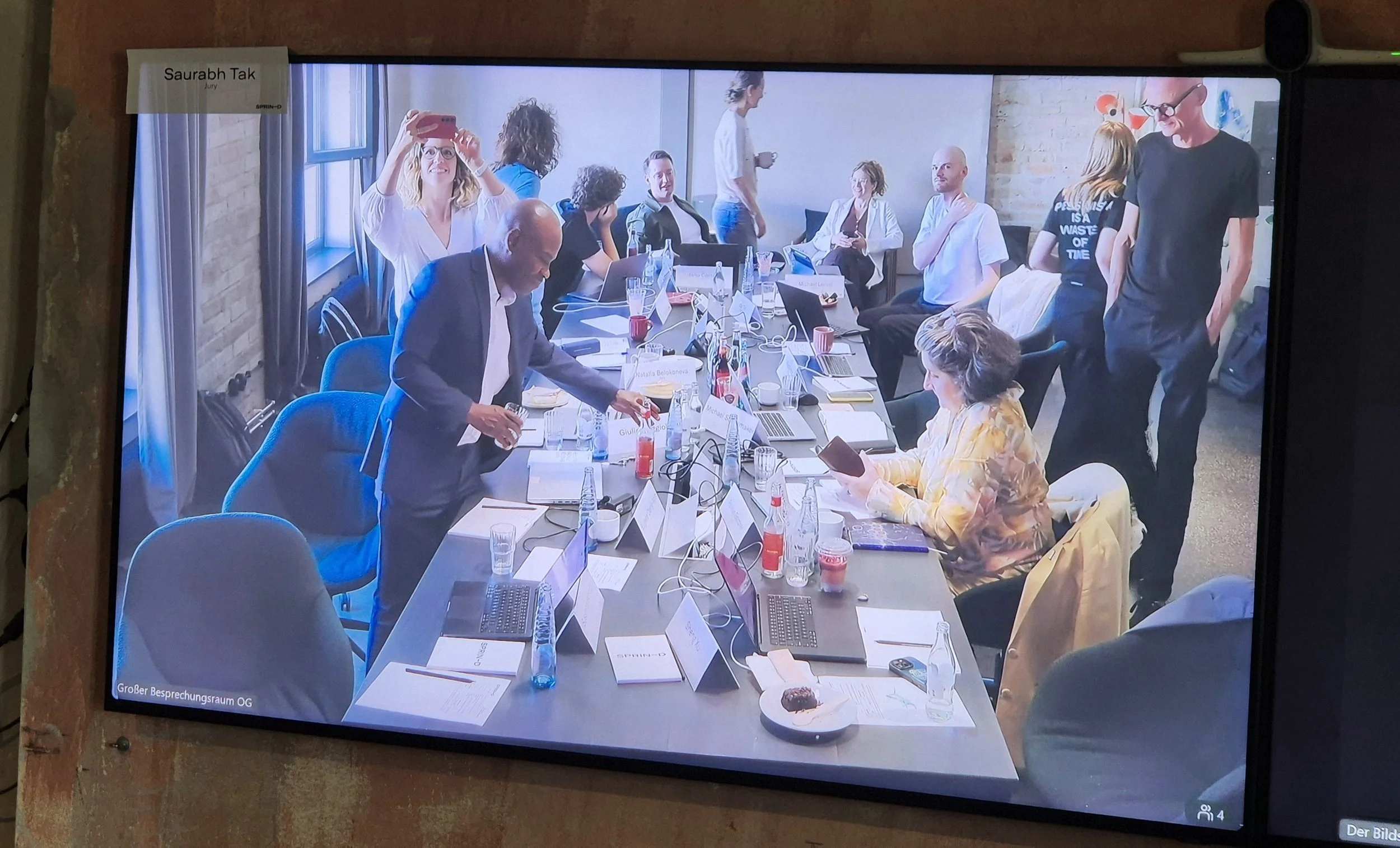
The jury table at SPRIND’s headquarters in Leipzig
References
Methodology note: This article is based on my original LinkedIn post (link), reflecting my experience serving on the jury for SPRIND's Continuous Hormone Monitoring Challenge. AI assisted in elaborating the topic into a broader article by researching and verifying the professional backgrounds of my fellow jury members and the Challenge's organising team from publicly available sources. All personal reflections and professional perspectives are my own, and all content has been reviewed by me for accuracy.
