
Eight teams at the edge of continuous hormone monitoring
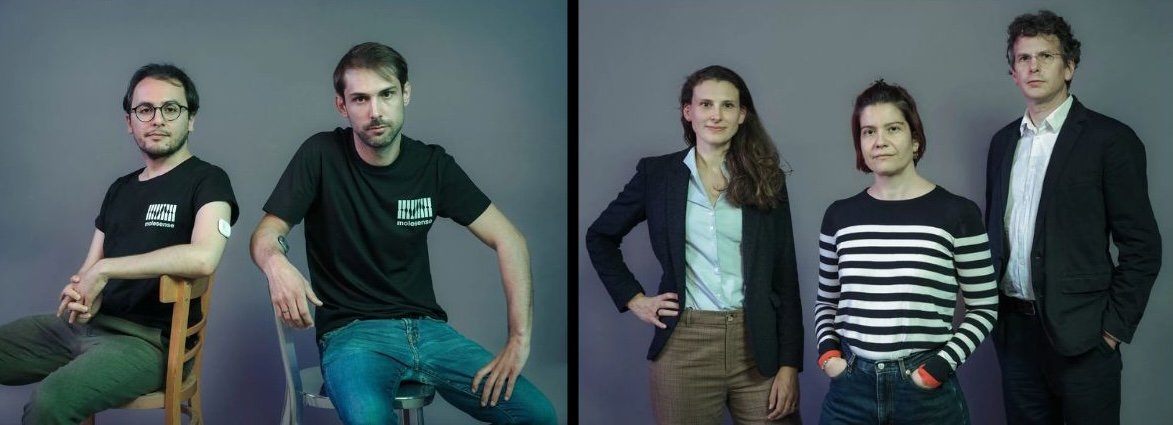
MoleSense and Impli: two Swiss-based teams among the eight who were awarded SPRIND Continuous Hormone Monitoring Challenge funding
After weeks of applications and a genuinely intense selection process, I can finally share the brilliant teams the jury had the privilege to hear and select for SPRIND's Continuous Hormone Monitoring Challenge. Here's a brief cluster analysis of what we saw, and what it tells us about where this field is actually heading.
Clustered by technology
FIVE of the eight teams are developing CGM-like, minimally invasive technology to measure hormones in subcutaneous interstitial fluid — the same biological compartment continuous glucose monitors already sample, just applied to a far harder analyte panel. Of those five, three rely on aptamer-based sensing, and two on other biochemistry, either enzymatic systems or living cells engineered to report on hormone levels.
TWO teams take a skin-applied approach instead, either sampling sweat directly or using optoacoustic sensing to read hormone signals non-invasively through the skin.
ONE team is building something more ambitious still: a fully implantable subcutaneous biochemical sensor, designed to run for the better part of a year.
Clustered by use case
FIVE teams target PMOS — polyendocrine metabolic ovarian syndrome, the condition long known as PCOS before its 2026 rename — as their first use case. It's an obvious first target: the lack of continuous hormone data has structurally prevented both accurate diagnosis and meaningful treatment monitoring for a condition that affects a substantial share of reproductive-age women.
TWO teams are aiming squarely at IVF management, hoping to replace the current regime of frequent blood draws with continuous data that enables better-timed extraction and inoculation.
ONE team is dedicated specifically to preventing spontaneous pre-term birth, a complication associated with detectable shifts in hormonal patterns that current single-point testing simply can't catch early enough to act on.
Where the real edge is: the open regulatory questions
As always, the edge is where innovation actually unfolds — it's practically an Edge Compliance motto at this point. A few things stood out from the regulatory side of these presentations:
MDR vs IVDR
Most teams struggled to pin down their regulatory strategy between MDR and IVDR — an understandable confusion given that a hormone sensor plausibly sits in either category depending on how its output is framed. A useful reference point here: continuous glucose monitors have already walked this exact path, and their classification history is publicly accessible in EUDAMED for anyone willing to look.
Adjunctive vs non-adjunctive
Many teams are still working out their FDA strategy across the wellness-to-adjunctive-to-non-adjunctive spectrum, and the De Novo versus 510(k) implications that follow from where a device lands on it. This isn't just semantics: FDA's own CGM history shows the difference concretely — adjunctive devices require a fingerstick to confirm before any treatment decision, while non-adjunctive, "integrated" CGM devices can stand alone as the basis for a treatment decision, and that distinction took the CGM field roughly two decades and multiple De Novo classifications to fully work out. A hormone-monitoring platform will have to walk a comparable path, ideally faster.
ISF vs blood matrix
There's a shared technical-and-regulatory challenge sitting underneath nearly every team's work: clinical protocols and reference ranges are built on hormone concentration cutoffs measured in blood, but most of these sensors measure in interstitial fluid, sweat, or another matrix entirely. Mapping ISF hormone concentration back to blood-based clinical cutoffs is a real scientific problem, and it's also, independently, a real regulatory problem — you can't validate a diagnostic claim against a reference standard that measures something structurally different from what your sensor actually reads.
Two more outstanding teams: the jury and the organisers
Ida Tin put together an incredible group of experts, capable of grasping the full technical picture, appreciating the regulatory borderlines, seeing the people behind each pitch, and evaluating with genuine care and foresight. Dr. Michael Schoemaker, Professor Eugene Oteng-Ntim, Rowan Gardner, Professor Sheng Xu, Professor Susanna Hofmann, Dr. Natalia Belokoneva, and Dr. Saurabh Tak made this one of the most intellectually engaged rooms I've sat in for a long time. And none of it runs without Marcia Holst, Jano Costard, and the rest of the SPRIND team handling the guidance and organisation behind the scenes.
The sheer combination of disciplines on display — physics, electronics, biochemistry, synthetic biology, microfluidics, physiology, and computing, all converging on a single sensor — was genuinely mind-blowing. Every part of my training got used in that room. Every single presentation — including from the teams we ultimately didn't select — taught me something, and gave my biochemistry, fairly dormant since my PhD, a genuinely welcome refresh.
What a privilege to be part of this group for the coming three years, as we re-evaluate each team's progress annually and continue investing in the startups showing the most promising potential and advancement.
To the eight teams
Oxense Bio, Impli, MoleSense, Level Zero Health, sThesis GmbH, Kāhu SiliconBio, Biomarq Health, and Phoebe — congratulations on what you've achieved so far, and all success in the journey ahead. Thank you for choosing to advance this field of technology, and women's health with it.
Every single presentation — including from the teams we ultimately didn't select — taught me something, and gave my biochemistry, fairly dormant since my PhD, a genuinely welcome refresh.

From Leipzig
References
SPRIND, Continuous Hormone Monitoring Challenge — official teams and challenge page
Forbes, Ida Tin Coined Femtech. Now She's Funding Continuous Hormone Monitoring, July 2026
MoleSense and Impli selected for SPRIND Challenge on Continuous Hormone Monitoring
Methodology note: This article is based on my original LinkedIn post (link), reflecting my experience as a jury member selecting the eight Stage 1 teams for SPRIND's Continuous Hormone Monitoring Challenge. AI assisted in elaborating the topic into a broader article by integrating background research on the selected teams' technologies and the regulatory frameworks referenced during the selection process. All analysis, cluster observations, and professional perspectives are my own, and all content has been reviewed by me for accuracy.
