
China's health tech is a decade ahead; synergise, don’t reinvent the wheel
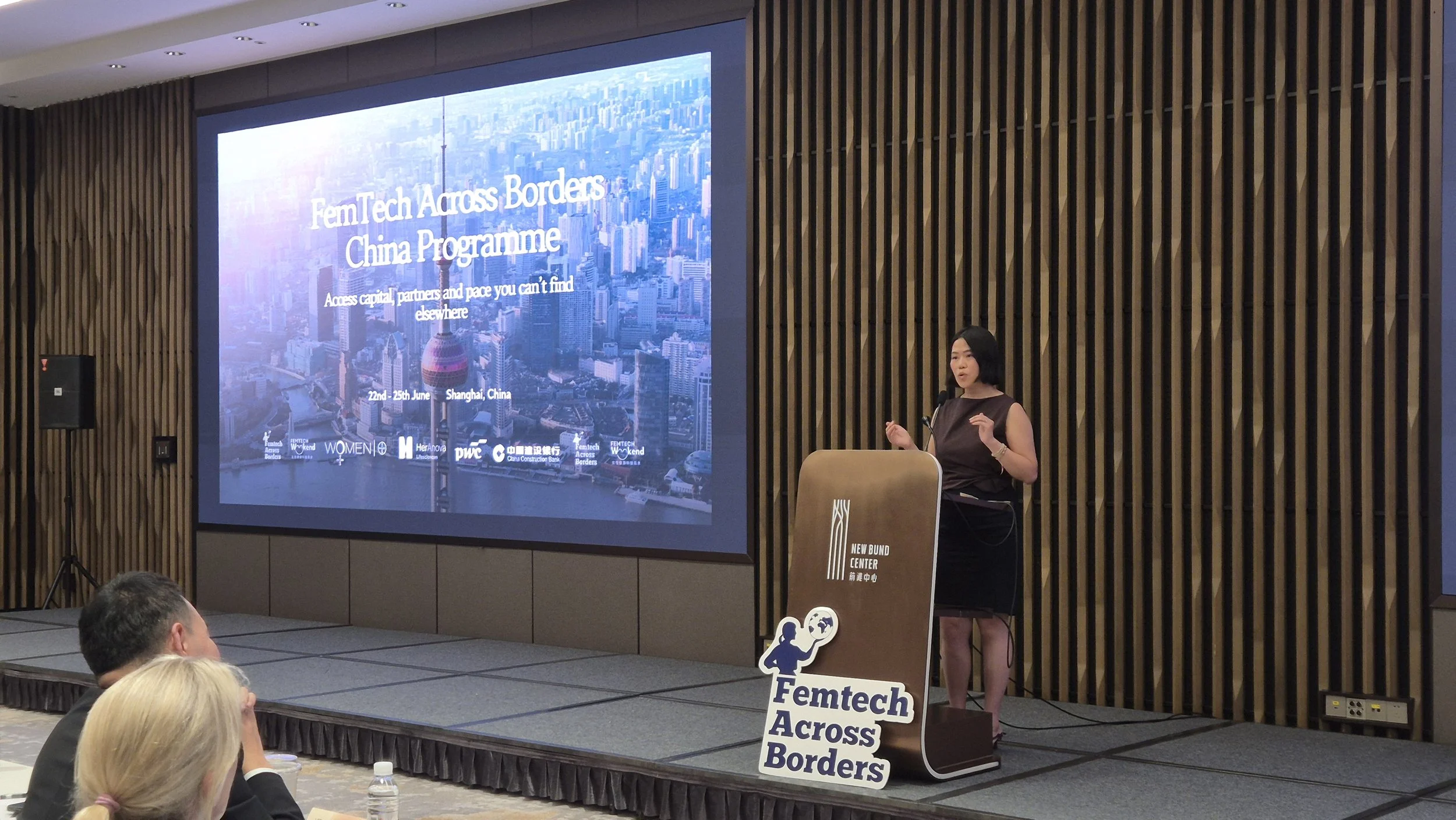
Zhu Yihan’s opening remarks at FemTech Across Borders China Programme
If you're fundraising in women's health, or you're curious about China's medtech space — and you should be — Zhu Yihan is the unlock.
Zhu Yihan leads Strategic & Scientific Investment at ROOT Technology Ltd., the Shenzhen-founded company behind Momcozy, a global mother-and-baby brand now serving millions of mothers across more than 60 countries, with a primary focus on markets outside China.
She's also the founder of FemTech Weekend and the host behind FemTech Across Borders' Shanghai Summit — a genuinely rare combination of operator, investor, and ecosystem-builder in one person. It's been a highlight of my week (in Zurich), and honestly of my whole year, to meet her.
What it unlocked for me
Had it not been for her, I wouldn't have made the trip to Shanghai this June. I wouldn't have had the genuinely exciting opportunity of running a booth for Edge Compliance, or of speaking on a panel about regulatory challenges and opportunities between China and the West.
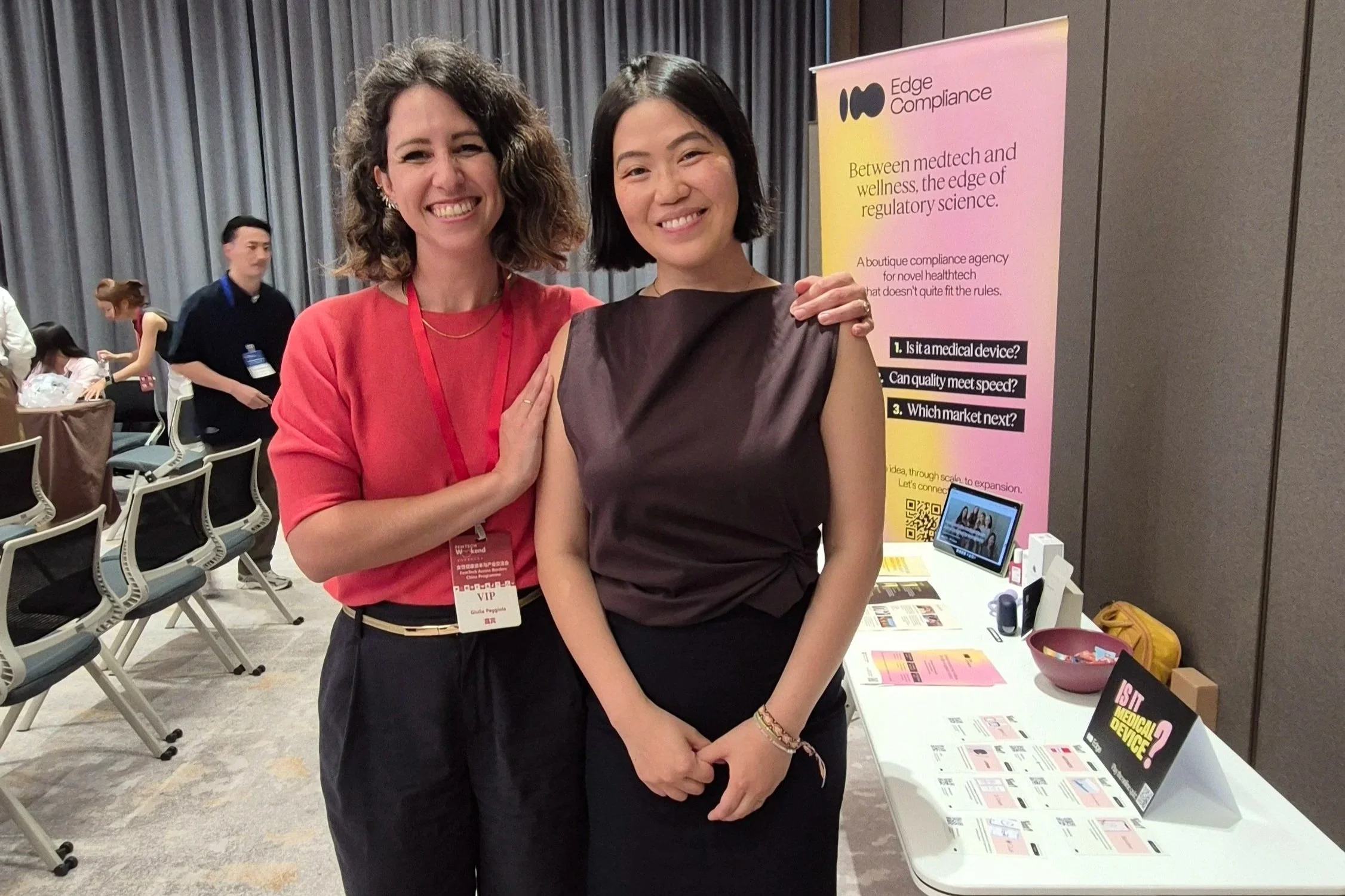
Giulia Paggiola with Zhu Yihan in Shanghai
The summit itself, held June 22-25 and hosted in partnership with Bayer Women's Healthcare, PwC China, and the Shanghai Government, brought together founders, investors, clinicians, policymakers, and ecosystem leaders from more than 40 countries — deliberately built not just as a networking event but around direct access to hospitals, corporates, regulators, and investors on the ground.
What I saw that changed how I think about "the future"
Above all, I wouldn't have seen firsthand how futuristic China already is about health technology, in ways we may only see in the West a decade from now — maybe:
AI-driven hospitals, with in-house teams of doctors designing and validating their own AI-assisted workflows, rather than adopting a vendor's off-the-shelf tool
WeChat, China's equivalent of WhatsApp, handling essentially all hospital-patient communication — booking appointments, accessing clinical records, telemedicine consultations, even payment and lab results, all inside a single super-app
VR-enabled remote surgery
Scarless abdominal surgery performed through the oral cavity, going beyond laparoscopy entirely
Full IoT monitoring of hospital equipment
A competitive startup environment that most of the West has essentially zero visibility into
As of a few years ago, tens of thousands of Chinese medical institutions had already set up official accounts or mini-programs on the platform, with the majority of hospitals offering smart healthcare services directly through it, and individual hospital-linked mini-programs now handling registration, appointment booking, payment, diagnostic scheduling, report retrieval, and full medical record access in a single integrated flow.
China didn't bolt digital health onto its existing healthcare infrastructure the way much of the West has; instead, it built the infrastructure around a platform people were already using dozens of times a day for everything else.
The counterpoint
What also amazed me, in stark contrast to this high-tech environment, is how deeply rooted and consistently adopted Traditional Chinese Medicine (TCM) still is.
It's not a niche or fringe practice sitting awkwardly alongside the AI hospitals and VR surgery — it coexists with them, genuinely mainstream, and it has a strong and direct influence on how the Chinese population perceives and adopts new technology and therapy.
Any Western company assuming its regulatory and clinical evidence playbook will translate cleanly into Chinese market adoption is missing half the picture; TCM isn't a competitor to be displaced, it's part of the cultural and clinical context any new therapy has to be understood alongside.
What comes next
I'm genuinely grateful to Zhu Yihan for inviting me to the FemTech Across Borders 2026 Summer Programme in Shanghai, and to her collaborators and team for sharing this knowledge and these contacts with me. She truly opened my eyes to China as a technology and capital frontier with enormous, largely untapped potential for women's health. A real treasure of a connection.
I look forward to seeing what she goes on to fund and build at the intersection of East and West. The edge is where innovation unfolds, and right now, that edge runs straight through Shanghai.
Zhu Yihan is based in London. If you're fundraising in women's health or exploring the China opportunity, it's worth reaching out directly.
References
FemTech Association Asia, China's First Global Femtech Summit, July 2026
FemTech Weekend, Shanghai Summit 2026 — Cross-Border Capital & Partnerships in Women's Health
CB Insights, 9 Ways The WeChat Super App Is Becoming The Front Door To Chinese Healthcare
Methodology note: This article is based on my original LinkedIn post (link), reflecting my personal experience at the FemTech Across Borders Shanghai Summit and my professional perspective on China's health technology landscape. AI assisted in elaborating the topic into a broader article by integrating background research on the summit, ROOT Technology, and the state of AI-enabled healthcare infrastructure in China. All personal reflections and professional perspectives are my own, and all content has been reviewed by me for accuracy.
