
Wearables in the race for ovulation accuracy
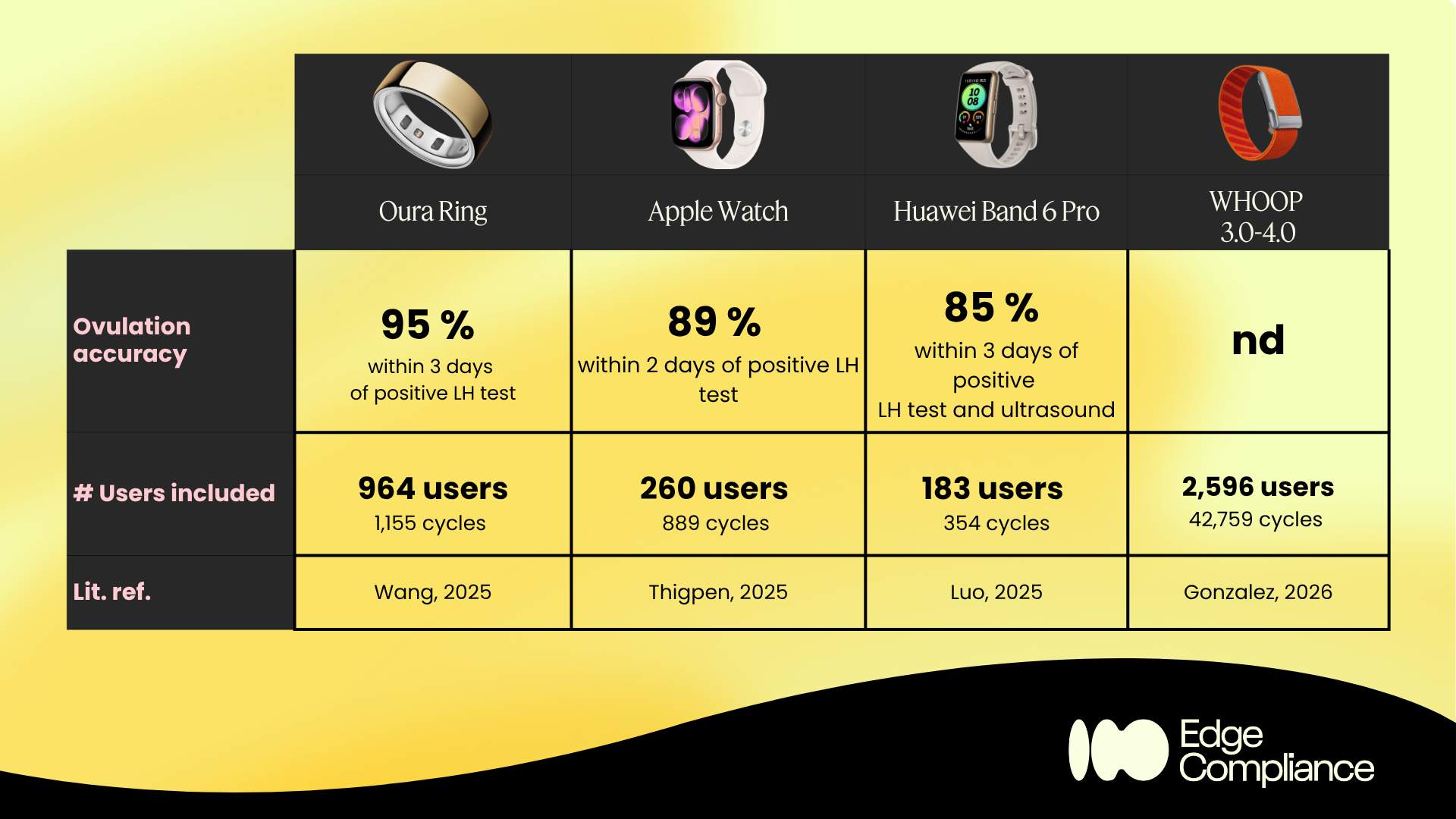
To be fair, everyone is criticizing Oura for its sleep accuracy, even via a US lawsuit, but nobody gives it credit for its impressive ovulation accuracy results.
In August 2026, California resident Madison Surber filed a proposed class action against Oura in the US District Court for the Northern District of California, alleging the company's "95% Sleep Staging Accuracy Compared to clinical sleep lab" and earlier "79% agreement" claims can't be reconciled with a ring that has no EEG, EOG, or EMG sensors, the instruments actual polysomnography relies on. The complaint cites an independent 2025 study that found Oura achieved roughly 53% accuracy in sleep-stage classification. Oura disputes the allegations and says it stands behind its published, peer-reviewed validation work. The case is unresolved, but it's become the headline story about Oura's credibility on physiological measurement.
What's getting lost in that headline
Even more notable: Apple, Oura, and Huawei have ALL started publishing in the ovulation-prediction space, each testing their own algorithm against a reference standard, and Oura's own results are genuinely strong.
A 2025 validation study in the Journal of Medical Internet Research, using 1,155 ovulatory cycles from 964 Oura users confirmed via home LH tests, found the ring's physiology-based method detected 96.4% of ovulations with an average error of 1.26 days, against 3.44 days for the calendar method. A separate Fertility and Sterility study validated the same algorithm against transvaginal ultrasound directly, the actual gold standard, and found it performed well within a one-day margin of error, outperforming the calendar method.
Apple has its own peer-reviewed result: a March 2025 Human Reproduction study of wrist-temperature algorithms on iPhone and Apple Watch, run as a registered prospective cohort study, concluding the approach can meaningfully estimate ovulation day and predict next menses across typical and atypical cycle lengths.
Medtech vs wellness approach
That distinction currently belongs to apps like Natural Cycles, FDA-cleared since 2018 as a Class II medical device via the De Novo pathway, and able to pull in wrist temperature data from a compatible Apple Watch (cleared in 2023) or Oura Ring (cleared in 2021) through separate 510(k) clearances. But the clearance sits with Natural Cycles, not with the wearable maker. Apple's own Cycle Tracking explicitly states its ovulation estimates should not be used as birth control and aren't intended to diagnose a health condition - although the feature is compliantly registered as a medical device Class I. Oura's ovulation feature carries no contraceptive or diagnostic claim either. The sensor hardware and the underlying temperature signal can be identical to what powers a cleared medical device; what changes the regulatory category is entirely the claim wrapped around it.
Also interesting: no FABM medical device has published on ovulation-prediction accuracy itself
Why? Because for medical devices, regulatory attention sits on clinical endpoints, and for fertility awareness-based methods that means either successful conception or successful avoidance of pregnancy. Ovulation prediction has to be accurate underneath that, but it functions as an internal KPI rather than publishing material, because the fertile window, not the exact ovulation day, is ultimately what the user needs to act on.
But ovulation accuracy is what users can actually check.
Ovulation accuracy is the most tangible parameter for a user, and one they can verify themselves, against their own body. If an app's estimate is too far off and doesn't adapt over subsequent cycles, users lose trust in it quickly, regardless of how sound its underlying clinical endpoint methodology is. That asymmetry, rigorous where regulators look, thin where users actually check, is exactly the kind of gap that erodes confidence even in a well-built product.
The accuracy ceiling
As with any software prediction, accuracy gets evaluated against a gold standard. For ovulation, the ground truth is ultrasound-observed follicular collapse, or, as a far more practical proxy, an at-home LH test. Technically, there's a real difference between physiological ovulation and the LH rise a positive test detects, which occurs earlier, and LH tests carry their own analytical performance limits against ultrasound: published comparisons of common OPKs report accuracy figures generally in the low-to-mid 90s against blood LH testing, though critics of these same studies have pointed out that a high headline accuracy figure can mask a meaningfully higher false-negative rate underneath it. So there's a real ceiling on the accuracy a wearable can demonstrate when validating against a practical home test, versus the far higher evidentiary burden of a study built on clinically supervised, multi-cycle confirmation, serial ultrasound plus serum hormones.
Interestingly, Huawei's study did exactly that. Conducted at Shanghai's International Peace Maternity and Child Health Hospital using the Huawei Band 5 alongside ovarian ultrasound and serum hormone confirmation, it reported meaningfully lower accuracy than Oura's headline figures, though on a different metric entirely, a machine-learning classification model rather than a straightforward "percentage within X days" figure, so the two results aren't directly comparable. The harder validation standard doesn't automatically produce a worse product; it produces a result that's simply measuring something closer to the true physiological event, which is a harder target to hit.
Interestingly, WHOOP hasn't gone down the validation path yet.
WHOOP hasn't published ovulation-prediction validation, although it has put out a large observational study, "The menstrual cycle through the lens of a wearable device," analyzing 1.2 million days of data from 2,596 women and over 42,000 logged cycles, conducted with Stanford's Wu Tsai Human Performance Alliance. It's genuinely useful population-level physiology research, showing how cycle length interacts with sleep and cardiorespiratory variability, but it's descriptive science, not a validated prediction algorithm with a reported accuracy figure against a reference standard.
The space is shifting fast
Not long ago this space was calendar-method apps and manual basal body temperature charting. Now it's continuous biometrics driving predictions, published in peer-reviewed journals, by companies that have no intention of seeking medical device status for the feature.
Being a medical device isn't the deciding factor here, and I disagree with colleagues who assume anything worn on the body must automatically be one.
You CAN display ovulation accuracy as a wellness feature, as long as you don't attach a claim about increased chances of conception or avoidance of pregnancy to it. But some platforms are pushing right up against that boundary, and the line between "here's your estimated ovulation day" and "use this to plan around pregnancy" is thinner in marketing copy than it is in a regulatory dossier.
This is the kind of analysis that sits at the center of Clinical Evaluation work for FABMs: reading published validation data across competitors, understanding exactly which reference standard each one used and why that changes what the number actually means, and mapping where a claim currently sits relative to where it could legally sit.
Would you call that compliance or competitive intelligence?
References
Surber v. Oura Inc. et al., No. 3:26-cv-08686, N.D. Cal., filed August 2026
Oura Health, Oura Ring as a Tool for Ovulation Detection: Validation Analysis, Journal of Medical Internet Research, 2025
Huddleston et al., Clinical Validation of Wearable Ring-Derived Algorithm for Ovulation Detection, Fertility and Sterility, 2025
Wang et al., Performance of algorithms using wrist temperature for retrospective ovulation day estimate and next menses start day prediction, Human Reproduction, 2025
Tracking of menstrual cycles and prediction of the fertile window via measurements of basal body temperature and heart rate, Huawei Band 5 study, Reproductive Biology and Endocrinology, 2022
Gonzalez et al., The menstrual cycle through the lens of a wearable device: insights into physiology, sleep, and cycle variability, WHOOP / Stanford Wu Tsai Human Performance Alliance
Natural Cycles, FDA clearance history for Apple Watch and Oura Ring integration
Apple Support, Receive retrospective ovulation estimates on Apple Watch
Methodology note: This article is based on my original LinkedIn post (link), reflecting my professional perspective on the regulatory treatment of ovulation-prediction claims across consumer wearables and FABM medical devices. AI assisted in elaborating the topic into a broader article by verifying the underlying validation studies, clearance history, and comparative methodologies referenced. All analysis and regulatory perspectives are my own, and all content has been reviewed by me for accuracy.
