
The high-risk wellness paradox of brain-stimulation wearables
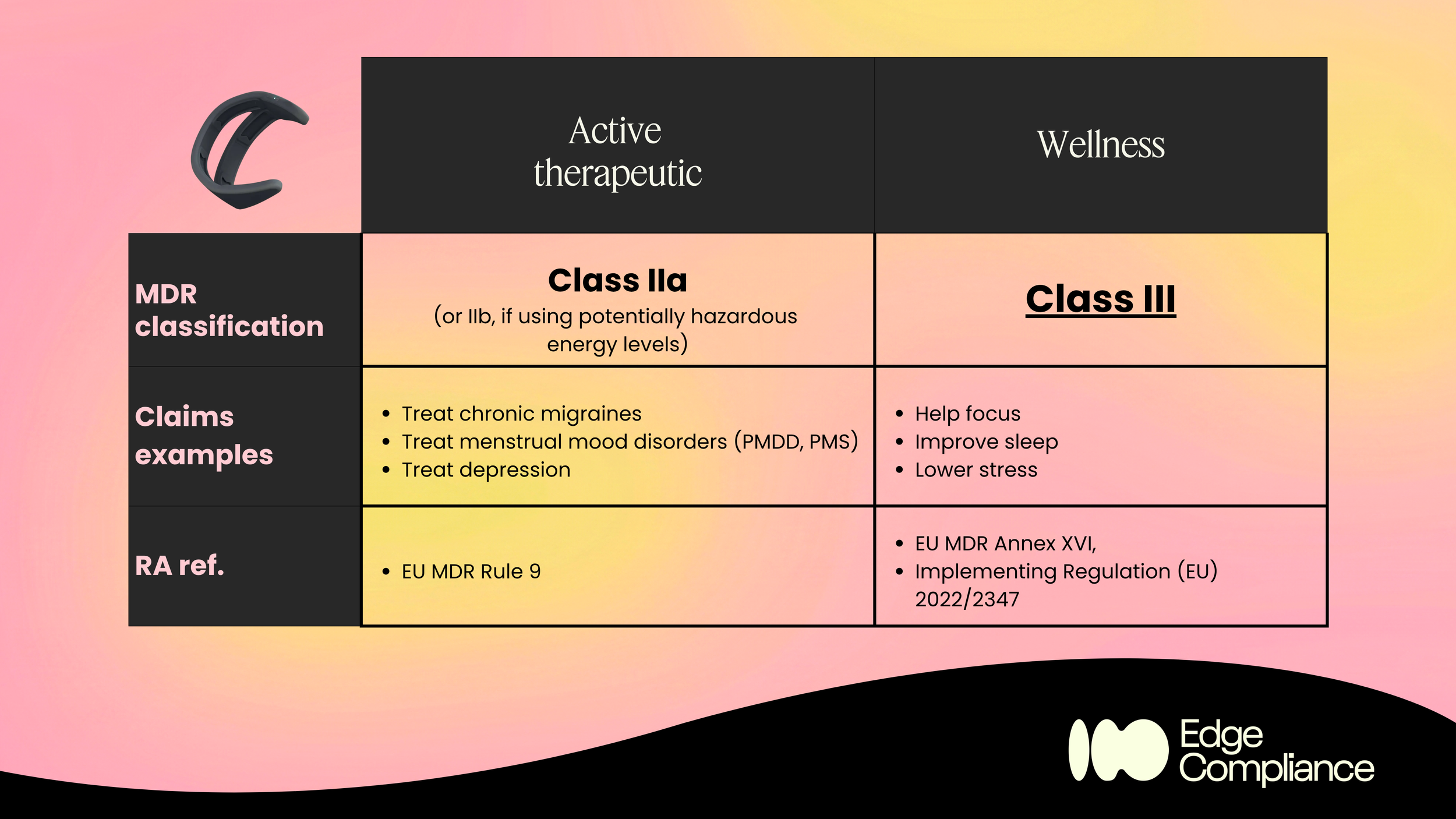
Refraining from a therapeutic purpose usually gets you a lower regulatory class, not a higher one. For brain stimulation wearables under EU law, it's upside down.
The therapeutic route
A brain stimulation device with a genuine medical purpose falls under Rule 9 of the MDR as an active therapeutic device: Class IIa, or IIb if the energy delivered is potentially hazardous given its nature, density, and the specific site of application. This is the standard, proportionate route most people would expect for a moderate-risk active device.
Samphire Neuroscience's Nettle headset is a real example. It's a transcranial Direct Current Stimulation (tDCS) device, CE-marked as a Class IIa medical device in the UK and EU, targeting the motor cortex and dorsolateral prefrontal cortex to manage pain and mood symptoms linked to the menstrual cycle, including PMS and PMDD. Clinical data behind the certification reported meaningful reductions in both pain and mood symptoms after a month of use.
Flow Neuroscience's device follows the identical pattern for a different indication. The Flow tDCS headset is CE-marked Class IIa under MDR for major depressive disorder, used as monotherapy or alongside antidepressants and psychological therapy, with results from a placebo-controlled trial published in Nature Medicine supporting its effectiveness. It's also received FDA Breakthrough Device Designation in the US, and is in use across NHS trusts and private clinics in the UK.
Now remove medical claim
What if you wanted to market a similar device simply for improving focus, sleep, or relaxation, with no therapeutic claim attached at all?
There's a special section of the MDR, Annex XVI, that regulates certain product categories with no intended medical purpose but a safety risk profile comparable to an actual medical device: coloured contact lenses, dermal fillers, fat-reduction equipment, IPL and laser hair removal, and, since a 2022 update, brain stimulation. The listed example is direct:
"Equipment intended for brain stimulation that apply electrical currents or magnetic or electromagnetic fields that penetrate the cranium to modify neuronal activity in the brain."
Commission Implementing Regulation (EU) 2022/2347 defines these, when marketed with no medical purpose, as Class III, the highest risk tier under MDR, above even the therapeutic version of the same technology. The regulation's own reasoning is explicit:
"[...] the use of such products may cause side effects, for example, atypical brain development, abnormal patterns of brain activity, increase metabolic consumption, fatigue, anxiety, irritability, headaches, muscle twitches, tics, seizures, vertigo and skin irritation at the electrode site. While such equipment is not surgically invasive, the electrical currents or magnetic or electromagnetic fields do penetrate the cranium to modify neuronal activity in the brain. Such modifications can have long-lasting effects and any unintended effects may be difficult to reverse. Such products should therefore be classified as Class III."
This isn't arbitrary. Rules 9 and 10 in Annex VIII, the standard active-device classification rules that would otherwise apply, are written around an intended medical purpose; they legally cannot apply to a device that disclaims one. Without a specific carve-out, a no-medical-purpose brain stimulator would default to Class I, the lowest tier, under the general fallback rule. The Commission judged that far too permissive given the actual risk profile, so 2022/2347 derogates from the standard rules entirely and places it straight into Class III instead.
The logic underneath the number: with no clinical benefit to weigh against the risks, the way there is for a therapeutic product, tolerance for risk should be lower, not higher, even though the resulting classification number reads the opposite way.
The critique
I find this contradicts Article 1(2) of the MDR, which states that products with no intended medical purpose, when brought under the Regulation, should be benchmarked against the same standards as analogous devices that do have a medical purpose, based on similar technology. Read against that principle, applying Class IIa rigour, the same standard the therapeutic version has to meet, should have been sufficient. Instead, the non-medical version ends up under materially heavier scrutiny, full-scrutiny Class III conformity assessment, than the therapeutic device treating an actual diagnosed condition.
It's worth noting this dynamic gets sharper still with dual-use products. If the same hardware platform carries both a therapeutic claim and any wellness-facing claim, MDR Article 1(3) requires the stricter classification to govern the entire product. A company can't quietly run a Class IIa therapeutic SKU alongside a Class III wellness SKU on the same platform and expect the therapeutic classification to hold; the wellness claim, however minor, pulls the whole thing up to Class III.
The market implications
The market response to this asymmetry is telling in itself. Samphire Neuroscience, for instance, sells Nettle as a Class IIa medical device in the EU and UK, but markets a separate, non-medical wellness version under a different name for the US market, where the calculus is entirely different, since FDA's jurisdiction turns on labelling and claims rather than on a fixed product-category list the way Annex XVI does. That's a live illustration of exactly the kind of jurisdiction-shopping this structural mismatch invites: the same underlying technology, positioned differently depending on which regulator's incentive structure a company is navigating. The US comparison is a genuinely different topic in its own right, and one worth its own dedicated look.
In conclusion, if you're developing TMS, CES, DBS, tDCS, tACS, or any of neuromodulation's other acronyms for the European market, the practical takeaway is stark: go all in on your claims and your clinical evidence of benefit, or don't play in this space at all. There is no accessible middle ground here, no low-risk wellness positioning to fall back on the way there might be for other borderline product categories. Forget the wellness route; in this specific corner of MDR, it's the more expensive one.
References
Regulation (EU) 2017/745 (MDR), Annex XVI and Article 1(2)-(3)
Commission Implementing Regulation (EU) 2022/2347, on the common specifications for Annex XVI Group 6 (brain stimulation equipment)
Samphire Neuroscience, Nettle, Class IIa CE-marked tDCS device for menstrual pain and mood
Flow Neuroscience, Class IIa CE-marked tDCS device for major depressive disorder
Samphire Neuroscience, US clinician page, on Lutea as a US wellness-market device alongside Nettle's EU/UK Class IIa status
Methodology note: This article is based on my original LinkedIn post (link), reflecting my professional experience and perspective on EU MDR classification of brain stimulation wearables. AI assisted in elaborating the topic into a broader article by verifying the underlying regulation text, product certifications, and market examples referenced. All regulatory analysis and opinions, including the critique of Article 1(2) consistency, are my own, and all content has been reviewed by me for accuracy.
